Noise analysis of OPAMPs
OPAMP, noise, amplifier
OPAMP gain
Figure 1 shows two types of OPAMP amplification modes.
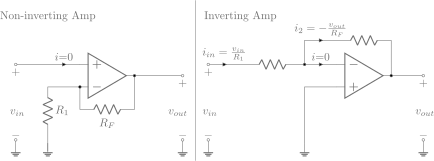
The gain analysis is done by setting \(v_-=v_+\) and \(i=0\) to get the input-output relations: \[\begin{eqnarray} v^{non-inv}_{out}=v_{in}\frac{R_F+R_1}{R_1},\, \text{and}\quad v^{inv}_{out}=-v_{in}\frac{R_F}{R_1} \label{eq:noninva}, \end{eqnarray}\]
A larger amplification can be achieved by selecting large \(\frac{R_F}{R_1}\). An OPAMP has inherent voltage and current noise. The current noise couples to the input impedance. The output noise can be calculated by projecting the noise sources into the input terminals[1]. Consider the non-inverting amp in Figure 2 for noise analysis.
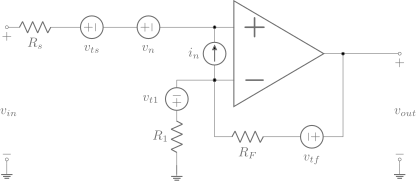
The voltages at the OPAMP inputs:
\[\begin{eqnarray} v_+=v_s+v_{ts}+v_n+i_n R_S = v_-=(v_o+v_{tf})\frac{R_1}{R_1+R_F}+v_{t1}\frac{R_F}{R_1+R_F} -i_n\frac{R_1 R_F}{R_1+R_F} \label{eq:vpm} \end{eqnarray}\]
Solving for the output noise:
\[\begin{eqnarray} v_o=(1+R_F/R_1)\left(v_s+v_{ts}+v_n+ \color{red}{i_n \left[R_S+\frac{R_1 R_F}{R_1+R_F}\right]}-\frac{v_{tf}R_1 +v_{t1}R_F}{R_1+R_F} \right) \label{eq:voutn} \end{eqnarray}\]
OPAMPs typically use BJTs in the input stages, which generate much greater noise currents at the input. These noise currents, flowing into high impedances, the red term in Eq. \(\ref{eq:voutn}\) , create large equivalent input noise.
Let us now consider the inverting amp in Figure 3 which shows the circuit diagram for noise analysis.
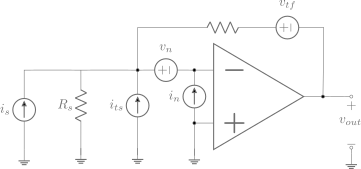
An alternative analysis method uses Norton equivalent elements. Thermal noise voltages can be converted to currents when convenient.
The voltages at the OPAMP inputs:
\[\begin{eqnarray} v_+=v_n+(i_s+i_{ts}+i_n) R_S||R_F +(v_{tf}+v_o)\frac{R_S}{R_S+R_F} = v_-=0 \label{eq:vpmn}. \end{eqnarray}\] Solve for the output noise: \[\begin{eqnarray} v_o=-\frac{R_F}{R_S}\left( R_S \left[i_s +i_{ts} +\frac{v_{tf}}{R_F}\right]+v_n \frac{R_F+R_S}{R_F} +\color{red}{i_n R_S}\right) \label{eq:voutnn} \end{eqnarray}\]
Again, we see the noise current, the red term in Eq. \(\ref{eq:voutnn}\) , flowing into high impedances \(R_S\), creating large equivalent noise.