Inductance of a Rectangular Loop
Electromagnetism, Magnetism
\(\require{cancel}\)
\(\require{cancel}\) \(\def\oot{\frac{1}{2}}\)
Vector Potential
The magnetic field at an arbitrary point \(\mathbf{r}\) created by a current distribution \(\mathbf{J}(\mathbf{r}')\) is given by the Biot-Savart law[1]:
\[\begin{eqnarray} \mathbf{B}(\mathbf{r}) &=&\frac{\mu_0 }{4\pi}\int d^3 \mathbf{r}'\frac{ \mathbf{J}(\mathbf{r}') \times ( \mathbf{r}- \mathbf{r}')}{ ( \mathbf {r}- \mathbf {r}')^3}, \label{eq:biotsavartlaw} \end{eqnarray}\] where we use the primed coordinates for the source points. We can convert this to a curl of a vector potential using the following identity: \[\begin{eqnarray} \bnabla\frac{1} {\left|\mathbf{r}- \mathbf{r}' \right|}&=&-\frac{\mathbf{r}- \mathbf{r}'}{|\mathbf{r}- \mathbf{r}'|^3} \label{eq:gradofrinv}. \end{eqnarray}\] Putting this into Eq. \(\ref{eq:biotsavartlaw}\) we get: \[\begin{eqnarray} \mathbf{B}(\mathbf{r}) &=&-\frac{\mu_0 }{4\pi}\int d^3 \mathbf{r}' \mathbf{J}(\mathbf{r}') \times \bnabla\frac{1} {\left|\mathbf{r}- \mathbf{r}' \right|} = \bnabla \times \left[ \frac{ \mu_0 }{ 4 \pi } \int d^3 \mathbf{r'} \frac{\mathbf{J}(\mathbf{r'})}{ | \mathbf {r}- \mathbf {r}'|} \right]\equiv \bnabla\times \mathbf{A}(\mathbf{r}). \label{eq:biotsavartlawcurl2} \end{eqnarray}\]
Equation \(\ref{eq:biotsavartlawcurl2}\) enables us to define a vector potential for an arbitrary current distribution:
\[\begin{eqnarray} \mathbf{A}(\mathbf{r}) &=& \frac{ \mu_0 }{ 4 \pi } \int d^3 \mathbf{r'} \frac{\mathbf{J}(\mathbf{r'})}{ | \mathbf {r}- \mathbf {r}'|} \label{eq:vpotdef}. \end{eqnarray}\]
Vector Potential of a Rectangular Loop
We consider the magnetic field of a single rectangular loop with sides of length \(L_1\) and \(L_2\), carrying a current \(I\). The loop lies in the \(z=0\) plane, centered at the origin, with sides parallel to the \(x\) and \(y\) axes.
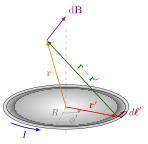
The rectangle extends from \(x = -L_1/2\) to \(L_1/2\) and \(y = -L_2/2\) to \(L_2/2\). The current flows counterclockwise around the loop. We’ll compute the vector potential by integrating over each of the four sides separately.
For a rectangular loop, it’s convenient to work in Cartesian coordinates. The current density for a thin wire can be written as a line current. For each side, we parameterize the current distribution.
The vector potential for a rectangular loop is computed by integrating over each of the four sides. For a line current: \[\begin{eqnarray} \mathbf{A}(\mathbf{r}) &=& \frac{ \mu_0 }{ 4 \pi } \int d^3 \mathbf{r'} \frac{\mathbf{J}(\mathbf{r'})}{ | \mathbf {r}- \mathbf {r}'|}=\frac{ \mu_0 I }{ 4 \pi R } \int d^3 \mathbf{r'}\frac{1 }{ | \mathbf {r}- \mathbf {r}'|} \delta(r'-R)\delta(\cos\theta')\left(\cos\phi' \hat{\mathbf{j}}-\sin\phi'\hat{\mathbf{i}} \right) \label{eq:vpotfull}, \end{eqnarray}\] where we put the subscript \(s\) to remind us that this is for a single loop. We will parameterize the points on the loop centered at \(z=0\) as \(\mathbf {r}'= r' (\cos\phi'\hat{\mathbf{i}}+\sin\phi'\hat{\mathbf{j}})\), and the observation point as \(\mathbf {r}= r\cos\theta \hat{\mathbf {z}}+ r\sin\theta (\cos\phi\hat{\mathbf{i}}+\sin\phi\hat{\mathbf{j}})\)
\[\begin{eqnarray} | \mathbf {r}- \mathbf {r}'|&=& \sqrt{r^2\cos^2\theta +(r\sin\theta\cos\phi -r'\cos\phi')^2+(r\sin\theta\sin\phi -r'\sin\phi')^2}\nonumber\\ &=&\sqrt{r^2+r'^2 -2 r r'\sin\theta\cos(\phi'-\phi)} \label{eq:deltar}. \end{eqnarray}\] Note that the problem has rotational symmetry. We can rotate our coordinate system such that the observation point sits on \(y=0\), i.e., \(\phi=0\). Once we are done with the computations, we can rotate the vectors back to general \(\mathbf{r}\) point. So let’s set \(\phi=0\) in Eq. \(\ref{eq:deltar}\) and rewrite Eq. \(\ref{eq:vpotfull}\) :
\[\begin{eqnarray} \mathbf{A}(\mathbf{r}) &=& \frac{ \mu_0 I }{ 4 \pi R } \int \sin\theta' r'^2 dr' d\phi' \frac{\delta(r'-R)\delta(\cos\theta')\left(\cos\phi' \hat{\mathbf{j}}-\sin\phi'\hat{\mathbf{i}} \right) }{ \sqrt{r^2+r'^2 -2 r r'\sin\theta\cos(\phi'-\phi)}} \nonumber\\ &=& \frac{ \mu_0 I R}{ 4 \pi } \left[ \int_{0}^{2\pi} d\phi' \frac{\cos\phi' \hat{\mathbf{j}} }{ \sqrt{r^2+R^2 -2 r R\sin\theta\cos(\phi'-\phi)}} \right.\nonumber\\ &&\quad\quad\quad \left.-\cancelto{0}{ \int_{0}^{2\pi} d\phi' \frac{\sin\phi'\hat{\mathbf{i}} }{ \sqrt{r^2+R^2 -2 r R\sin\theta\cos(\phi'-\phi)}} } \right] \label{eq:vpotfull2}, \end{eqnarray}\] where the second term vanishes since the integrand is odd and the integral is evaluated over the full range. Note that we evaluated the integral at \(\phi=0\), and the resulting potential points in \(\hat{\mathbf{j}}\) direction. For generic \(\phi\) we can simply rotate the coordinate system about the \(z\) axis by \(\phi\). In this rotated coordinate system \(\hat{\mathbf{j}}\rightarrow \hat{\phi}\). Therefore the vector potential reads: \[\begin{eqnarray} \mathbf{A}(\mathbf{r}) &=& \hat{\phi}\frac{ \mu_0 I R}{ 4 \pi } \int_{0}^{2\pi} d\phi' \frac{\cos\phi' }{ \sqrt{r^2+R^2 -2 r R\sin\theta\cos\phi'}} \label{eq:vpotfullrot}. \end{eqnarray}\] Let’s define \(\phi'=\pi-\phi'\) to get \(\cos\phi'=-\cos\phi'\) and rewrite Eq. \(\ref{eq:vpotfullrot}\) as: \[\begin{eqnarray} \mathbf{A}(\mathbf{r}) &=& -\hat{\phi}\frac{ \mu_0 I R}{ 4 \pi } \int_{-\pi}^{\pi} d\phi' \frac{\cos\phi' }{ \sqrt{r^2+R^2 +2 r R\sin\theta\cos\phi'}} \label{eq:vpotfullrot2}. \end{eqnarray}\] Let’s also use the half angle formula: \(\cos\phi'=1-2\sin^2\frac{\phi'}{2}\) and reorganize the integral: \[\begin{eqnarray} \mathbf{A}(\mathbf{r}) &=& -\hat{\phi}\frac{ \mu_0 I R}{ 4 \pi } \frac{1}{\sqrt{r^2+R^2 +2 r R\sin\theta}}\int_{-\pi}^{\pi} d\phi' \frac{1-2\sin^2\frac{\phi'}{2} }{ \sqrt{1 -\frac{4 r R\sin\theta}{r^2+R^2 +2 r R\sin\theta}\sin^2\frac{\phi'}{2}}}\nonumber\\ &\equiv& -\hat{\phi}\frac{ \mu_0 I R}{ 4 \pi } \frac{1}{\sqrt{r^2+R^2 +2 r R\sin\theta}}\int_{-\pi}^{\pi} d\phi' \frac{1-2\sin^2\frac{\phi'}{2} }{ \sqrt{1 -k^2\sin^2\frac{\phi'}{2}}} \nonumber\\ &=& -\hat{\phi}\frac{ \mu_0 I R}{ 4 \pi } \frac{1}{\sqrt{r^2+R^2 +2 r R\sin\theta}}\int_{-\pi}^{\pi} d\phi' \left[\frac{1 }{ \sqrt{1 -k^2\sin^2\frac{\phi'}{2}}}-2 \frac{\sin^2\frac{\phi'}{2} }{ \sqrt{1 -k^2\sin^2\frac{\phi'}{2}}}\right] \nonumber\\ &=& -\mathbf{\hat{\phi}}\frac{ \mu_0 I R }{ 4 \pi k^2} \frac{1}{ \sqrt{r^2+R^2 +2 r R\sin\theta}}\int_{-\pi}^{\pi} d\phi' \left[\frac{k^2-2 }{ \sqrt{1 -k^2\sin^2\frac{\phi'}{2}}}+2 \sqrt{1 -k^2\sin^2\frac{\phi'}{2}} \right] \label{eq:vpotfullrot3}, \end{eqnarray}\]
where \(k^2=\frac{4 r R\sin\theta}{r^2+R^2 +2 r R\sin\theta}\). Finally, we define \(\zeta'=\phi'/2\) and split the integration into two pieces to pick an overall factor of \(4\) to get: \[\begin{eqnarray} \mathbf{A}(\mathbf{r})=\hat{\phi}\frac{ \mu_0 I R}{ \pi \sqrt{r^2+R^2 +2 r R\sin\theta} } \frac{(2-k^2)K(k^2)-2E(k^2)}{k^2} \label{eq:vpotfullrotf}, \end{eqnarray}\]
where the elliptic integral are defined as follows: \[\begin{eqnarray} K(k^2)&=&\int_0^{\frac{\pi}{2}}\frac{d\theta}{\sqrt{1-k^2\sin^2\theta}},\nonumber\\ E(k^2)&=&\int_0^{\frac{\pi}{2}}d\theta\sqrt{1-k^2\sin^2\theta} \label{eq:elliptic}. \end{eqnarray}\]
Magnetic Field of a Rectangular Loop
The magnetic field is computed from \(\mathbf{B} = \nabla \times \mathbf{A}\). For the rectangular loop, we have:
\[\begin{eqnarray} B_r&=&\frac{1}{r\sin\theta}\frac{\partial}{\partial\theta}(\sin\theta A_\phi)=\frac{ \mu_0 I R^2 \cos\theta E(k^2) }{ \pi \sqrt{r^2+R^2 +2 r R\sin\theta} (r^2+R^2 -2 r R\sin\theta)},\nonumber\\ B_\theta&=&-\frac{1}{r}\frac{\partial}{\partial r}(r A_\phi)=\frac{ \mu_0 I \left[(r^2+R^2\cos(2\theta) )E(k^2)-(r^2+R^2 -2 r R\sin\theta)K(k^2)\right] }{ 2 \pi \sqrt{r^2+R^2 +2 r R\sin\theta} (r^2+R^2 -2 r R\sin\theta)\sin\theta} \label{eq:ellipticB}. \end{eqnarray}\]
We can also express the magnetic field in the cylindrical coordinates [2]: \[\begin{eqnarray} B_\rho&=&\frac{ \mu_0 I z \left[ (R^2+\rho^2+z^2)E(k^2)-(R^2+\rho^2+z^2 -2 R \rho))K(k^2)\right] }{ 2 \pi \sqrt{R^2+\rho^2+z^2 +2 R \rho} (R^2+\rho^2+z^2 -2 R \rho)\rho},\nonumber\\ B_z&=&\frac{ \mu_0 I \left[ (R^2-\rho^2-z^2)E(k^2)+(R^2+\rho^2+z^2 -2 R \rho))K(k^2)\right] }{ 2 \pi \sqrt{R^2+\rho^2+z^2 +2 R } (R^2+\rho^2+z^2 -2 R \rho)\rho} \label{eq:ellipticBc}. \end{eqnarray}\]
Self-Inductance of a Rectangular Loop
The self-inductance \(L\) of a rectangular loop with sides \(L_1\) and \(L_2\) is defined as the ratio of the magnetic flux through the loop to the current producing it:
\[\begin{eqnarray} L = \frac{\Phi}{I}, \label{eq:inductancedef} \end{eqnarray}\]
where \(\Phi\) is the magnetic flux through the loop area. The flux can be computed using Stokes’ theorem by integrating the vector potential around the rectangular loop:
\[\begin{eqnarray} \Phi = \oint \mathbf{A} \cdot d\mathbf{l} = \int_{\text{loop}} \mathbf{A} \cdot d\mathbf{l}, \label{eq:fluxstokes} \end{eqnarray}\]
where the integral is over the four sides of the rectangle. For a rectangular loop, we evaluate the vector potential on each side separately.
For a rectangular loop, the self-inductance calculation is more complex than for a circular loop because we must integrate the vector potential over four straight segments. The key challenge is handling the logarithmic divergences that occur when evaluating the vector potential at points on the wire itself.
For a thin wire of radius \(a \ll L_1, L_2\), we compute the self-inductance by evaluating the vector potential on each side of the rectangle, accounting for the finite wire thickness. The calculation involves integrating the contributions from all four sides.
The vector potential on each side receives contributions from: 1. The same side (self-term, which diverges logarithmically) 2. The opposite parallel side 3. The two adjacent perpendicular sides
For a rectangular loop with sides \(L_1\) and \(L_2\), the self-inductance for thin wire (\(a \ll L_1, L_2\)) is given by grover1946inductance?:
Now we need the asymptotic behavior of the elliptic integrals as \(k^2 \to 1\). For \(k^2\) close to 1, we have:
\[\begin{eqnarray} K(k^2) &\approx& \ln\left(\frac{4}{\sqrt{1-k^2}}\right) + \mathcal{O}(1-k^2), \nonumber\\ E(k^2) &\approx& 1 + \mathcal{O}(1-k^2). \label{eq:ellipticasymp} \end{eqnarray}\]
Substituting \(k^2 \approx 1 - a^2/R^2\) into Eq. \(\ref{eq:vpotstart}\):
\[\begin{eqnarray} A_\phi &\approx& \frac{\mu_0 I R}{\pi \sqrt{4R^2}} \frac{(2-(1-a^2/R^2))\ln(4R/a) - 2}{1-a^2/R^2} \nonumber\\ &\approx& \frac{\mu_0 I}{2\pi} \left[(1+a^2/R^2)\ln(4R/a) - 2 + \mathcal{O}(a^2/R^2)\right] \nonumber\\ &\approx& \frac{\mu_0 I}{2\pi} \left[\ln(4R/a) - 2 + \mathcal{O}(a^2/R^2)\right]. \label{eq:aphiapprox} \end{eqnarray}\]
However, this gives the vector potential at a single point. To get the flux, we need to integrate around the loop. The flux is:
\[\begin{eqnarray} \Phi = \oint \mathbf{A} \cdot d\mathbf{l} = R \int_0^{2\pi} A_\phi(R, \phi) d\phi. \label{eq:fluxintegral} \end{eqnarray}\]
The subtlety is that when we integrate around the loop, we’re averaging the vector potential over all points on the loop. For each point on the loop, the vector potential receives contributions from all other points on the loop. The logarithmic divergence comes from points that are close together.
A more careful analysis shows that when averaging the distance between points on a circle, the effective minimum distance in the logarithm is not \(2a\) but rather involves a geometric factor. Specifically, for a circular loop, the average of \(\ln(|\mathbf{r} - \mathbf{r}'|)\) over all pairs of points on the loop gives rise to the factor of 8 grover1946inductance?.
The complete derivation involves: 1. Writing the vector potential as an integral over the loop 2. Averaging over the loop circumference 3. Extracting the logarithmic divergence carefully 4. Accounting for the finite wire thickness
The final result is:
\[\begin{eqnarray} L = \frac{\mu_0}{\pi} \left[L_1 \ln\left(\frac{2L_1}{a}\right) + L_2 \ln\left(\frac{2L_2}{a}\right) + 2\sqrt{L_1^2 + L_2^2} - L_1 \sinh^{-1}\left(\frac{L_1}{L_2}\right) - L_2 \sinh^{-1}\left(\frac{L_2}{L_1}\right) - \frac{L_1 + L_2}{2}\right] + \mathcal{O}\left(\frac{a}{L_1}, \frac{a}{L_2}\right), \label{eq:inductanceapprox} \end{eqnarray}\]
where \(a\) is the wire radius. This formula accounts for the contributions from all four sides and the corner effects. The logarithmic terms come from the self-inductance of each straight segment, while the square root and inverse hyperbolic sine terms account for mutual inductance between parallel and perpendicular segments grover1946inductance?.
For a square loop (\(L_1 = L_2 = L\)), this simplifies to:
\[\begin{eqnarray} L = \frac{\mu_0 L}{\pi} \left[2\ln\left(\frac{2L}{a}\right) + 2\sqrt{2} - 2\sinh^{-1}(1) - 1\right] = \frac{\mu_0 L}{\pi} \left[2\ln\left(\frac{2L}{a}\right) + 0.378\right], \label{eq:inductancesquare} \end{eqnarray}\]
where we used \(\sinh^{-1}(1) = \ln(1+\sqrt{2})\).
For the exact calculation using elliptic integrals, we evaluate the vector potential at a point near the loop. Taking the limit as the observation point approaches the loop (but staying at a finite distance \(a\) from the wire center), the self-inductance can be expressed as:
\[\begin{eqnarray} L = \mu_0 R \left[\ln\left(\frac{8R}{a}\right) - 2 + \frac{a}{R}\left(\ln\left(\frac{8R}{a}\right) + \frac{1}{4}\right) + \mathcal{O}\left(\frac{a^2}{R^2}\right)\right]. \label{eq:inductanceexact} \end{eqnarray}\]
The leading term \(\mu_0 R \ln(8R/a)\) dominates for thin wires and shows the characteristic logarithmic dependence on the aspect ratio \(R/a\). The constant term \(-2\) comes from the detailed structure of the elliptic integrals in the limit \(k^2 \to 1\).
An alternative approach is to compute the flux directly by integrating the magnetic field over the loop area. Using the \(B_z\) component from Eq. \(\ref{eq:ellipticBc}\) at \(z=0\) and integrating over the circular disk:
\[\begin{eqnarray} \Phi = \int_0^{2\pi} \int_0^R B_z(\rho, z=0) \rho d\rho d\phi. \label{eq:fluxdirect} \end{eqnarray}\]
This integral also leads to the same logarithmic form, confirming the self-inductance expression above.